

For many Overseas Filipino Workers (OFWs), processing documents for overseas employment, migration, or residency ranks among the most challenging steps before deployment. Each destination country sets its own embassy requirements, which include certified copies and translated documents in the host country’s official language. Understanding these rules early ensures that you submit every certificate, clearance, and contract abroad in a valid, readable, and embassy-approved form.
TL;DR
OFWs meet each country’s embassy requirements by submitting verified documents such as passports, visas, and employment papers, along with certified translations of non-English records. Some embassies request Arabic or sworn translations to ensure legal validity. Elite Translations helps OFWs comply by providing accurate translations and interpreter support for embassy submissions.
What Are the Embassy Requirements for OFWs?
Before deployment, OFWs prepare an extensive set of documents for submission to both the Philippine government and the destination country’s embassy. These documents prove their identity, qualifications, and legal eligibility to work abroad. However, embassies differ in how they validate these papers, as some accept English while others require translations into their national language.
Commonly required embassy documents include:
- Passport and visa/permit – Your basic identification and proof of authorization to enter and work abroad.
- Overseas Employment Certificate (OEC) – Verification of legal employment through the Department of Migrant Workers (DMW).
- Employment contract and Certificate of Employment – Required by most labor attachés and embassy offices.
- Training certificates or TESDA credentials – For skilled workers or specialized profession
- Personal and civil documents – Such as birth, marriage, or divorce certificates.
- Police clearances (NBI) – To certify a clean criminal record.
- Educational diplomas and transcripts – Needed for skilled or professional visa categories.
Certainly, when you ensure that all documents remain accurate, updated, and translated according to embassy standards, you save time and prevent costly delays. Moreover, you must usually accompany any document issued in Filipino with a certified English or host-language translation.
Other Embassy Requirements for OFWs To Prepare
While document translation plays a crucial role, embassy requirements for OFWs extend beyond language compliance. Therefore, workers also prepare for other procedural and logistical steps that determine how smoothly their applications progress.
Here are the other essential embassy requirements to anticipate:
- Appointment Scheduling: Most embassies now require online booking before submission. Slots can fill up fast, especially during deployment peaks. Hence, booking early helps avoid last-minute delays and ensures timely processing.
- Authentication and Legalization: Some embassies still require apostilled or authenticated copies of documents, even after translation. This step verifies the document’s legitimacy and may involve the Department of Foreign Affairs (DFA) or notarial offices.
- Payment of Processing Fees: Embassy fees vary per country and type of service. Some accept electronic payments, while others only allow in-person transactions. Moreover, certain embassies require payment in local currency—so double-check before your appointment.
- Interview Preparation: Many embassies conduct personal or online interviews to validate employment or visa applications.
- Supporting Documentation: Apart from main credentials, embassies often ask for supporting papers such as photos, proof of funds, or employer letters.
Ultimately, embassy requirements for OFWs involve more than simply submitting translated paperwork. Practically, when you act proactively, you make the process efficient and avoid unnecessary rework or missed deadlines.
Why Is Document Translation Required by Embassies?
Embassies verify both the authenticity and comprehensibility of each document. Hence, you need to translate your paperwork when it is not in the official language of your destination country.
For instance:
- The United Arab Emirates (UAE) mandates that all visa and immigration papers be submitted in Arabic or with certified Arabic translations.
- Saudi Arabia requires certified translations for nearly all foreign-issued documents from birth certificates to police clearance.
- European countries like Spain, Germany, and Slovenia all require translations. In some cases, a sworn translation may be needed.
- On the other hand, English-speaking nations such as the U.S., Canada, and the U.K. typically require certified English translations if the originals are in another language.
So, before your embassy appointment, verify which type of translation, certified or sworn, you need to submit. Doing so ensures that authorities legally recognize and immediately accept your papers.
What Is the Difference Between Certified and Sworn Translations?
Understanding these two types of translations helps you choose the right service for your application.
A certified translation includes a professionally translated document and a signed statement from the translator affirming its accuracy and completeness. Embassies, schools, and government offices commonly accept it for most standard purposes.
Meanwhile, a sworn translation carries additional legal authority. An accredited translator performs it and takes an official oath guaranteeing accuracy. Countries such as Italy, Spain, and Germany often require this type for legal proceedings, immigration cases, or court documents.
Hence, if your destination embassy specifies “sworn” or “legalized” translations, submitting a certified version alone may not suffice. Elite Translations can provide either, ensuring that every translation complies with each country’s legal framework.
Documents Requiring Translation for Embassy Submissions
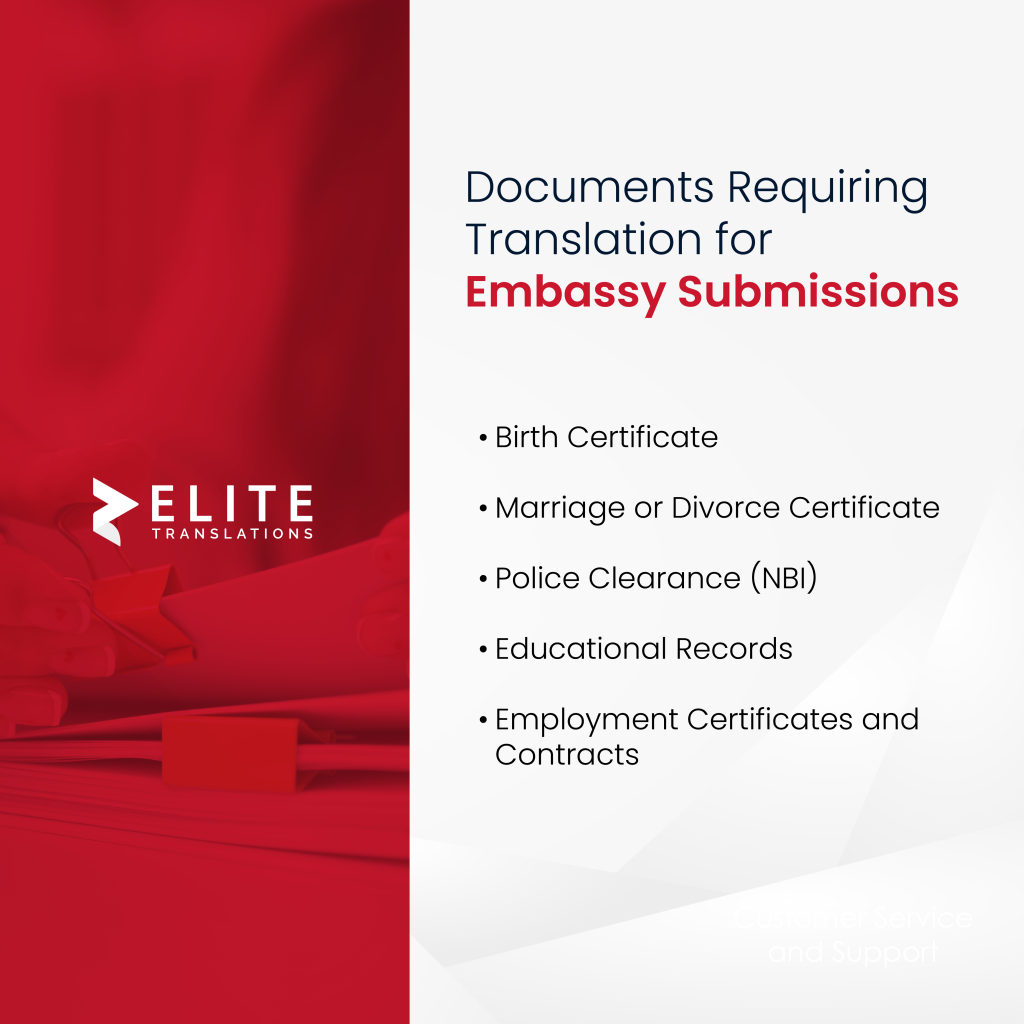
While each embassy has unique requirements, certain document categories almost always need translation. These include:
- Birth Certificate – Confirms identity and nationality; often needs certified translation and apostille.
- Marriage or Divorce Certificate – Proves marital status for family or spousal visa applications.
- Police Clearance (NBI) – Required for moral character verification; foreign agencies prefer English or host-country versions.
- Educational Records – Diplomas and transcripts validate professional qualifications abroad.
- Employment Certificates and Contracts – Translated copies allow employers and embassies to verify employment terms.
Before submitting, check that all entries are readable, consistent, and free of errors. Furthermore, if your destination embassy uses a non-English language (such as Arabic or Spanish), it’s best to submit both the original and a certified translation to avoid rejection or resubmission.
How Does Elite Translations Help With Embassy Requirements?
Elite Translations is a trusted partner for thousands of Filipinos preparing their documents for overseas employment. With more than 15 years of experience in professional language services, Elite provides certified, sworn, and embassy-compliant translations that ensure your papers meet international standards.
Here’s how Elite Translations supports OFWs with embassy requirements:
- Certified Document Translation: Elite’s expert linguists translate key documents such as birth and marriage certificates, NBI clearances, educational diplomas, and employment contracts into over 150 languages.
- Sworn Translations: For countries like Italy or Spain, Elite works with authorized sworn translators who issue legally recognized translations complete with the required oath and seal.
- Interpreting Services: During embassy interviews or visa appointments, Elite’s professional interpreters facilitate smooth, accurate communication to prevent misunderstandings.
Truly, by partnering with Elite Translations, you eliminate guesswork and gain confidence that every file you submit abroad is compliant, legible, and professionally prepared.
Ready to Start Your Preparation?
Don’t let incomplete or untranslated paperwork delay your overseas career. Start your embassy compliance early by preparing certified and properly translated documents. Contact Elite Translations today for expert assistance with your embassy requirements.
FAQs
Q: What documents do OFWs need to translate?
A: Birth and marriage certificates, NBI clearances, diplomas, and employment contracts. If any of these are not in English or your host country’s language, you must submit a certified translation alongside the original copy.
Q: Which countries have the strictest embassy translation requirements?
A: The UAE, Saudi Arabia, and Spain are among the strictest, requiring Arabic and Spanish translations respectively of nearly all documents.
Q: Why should OFWs choose Elite Translations?
A: Elite Translations combines accuracy, cultural understanding, and global compliance. With certified and sworn translators, embassy formatting expertise, and personalized support, Elite helps OFWs meet every embassy requirement efficiently.