

The Filipino Language is more than a tool for everyday communication. It represents national identity, cultural pride, and unity in a country of remarkable linguistic diversity. As the official national language, Filipino provides a common voice for Filipinos at home and abroad. Therefore, to understand Philippine society and to connect with Filipino communities worldwide, one must also understand the Filipino Language.
In this blog, we will explore its origins, its role in modern society, common misconceptions, and its growing relevance globally. Finally, we will share how Elite Translations supports individuals and organizations in navigating the Filipino Language for academic, legal, professional, and cultural purposes.
TL;DR
The Filipino Language is the Philippines’ national tongue, uniting more than 180 local languages and serving as a bridge in global communities. Rooted in Tagalog yet enriched by Spanish, English, and other Philippine languages, it has grown into a symbol of identity and connection. Understanding its origins, role in society, and global impact is key for individuals, institutions, and businesses. With professional support from Elite Translations, you can ensure accurate and culturally sensitive Filipino communication, whether for documents, interpretation, or outreach.
What Is the Filipino Language?


The Filipino Language is one of the two official languages of the Philippines, alongside English. It functions as the national lingua franca, bridging communication among over 180 ethnic and linguistic groups across the archipelago.
To illustrate its core characteristics:
- Derived from Tagalog – The foundation of Filipino is Tagalog, historically spoken in Manila and surrounding provinces.
- Influence of foreign languages – Filipino has absorbed thousands of words from Spanish, English, and other Philippine tongues.
- Alphabet and script – Today, it uses a 28-letter Latin alphabet, though interest in reviving Baybayin, a pre-colonial script, continues to grow.
- Number of speakers – Approximately 83 million people speak Filipino as a first or second language, within the Philippines and in global Filipino communities.
Consequently, Filipino is not only taught in schools but also serves as the working language of government, media, and commerce. It unites Filipinos domestically while strengthening connections abroad.
Origins of the Filipino Language


Understanding the origins of the Filipino Language reveals how it evolved into a unifying force shaped by history, colonization, and nation-building.
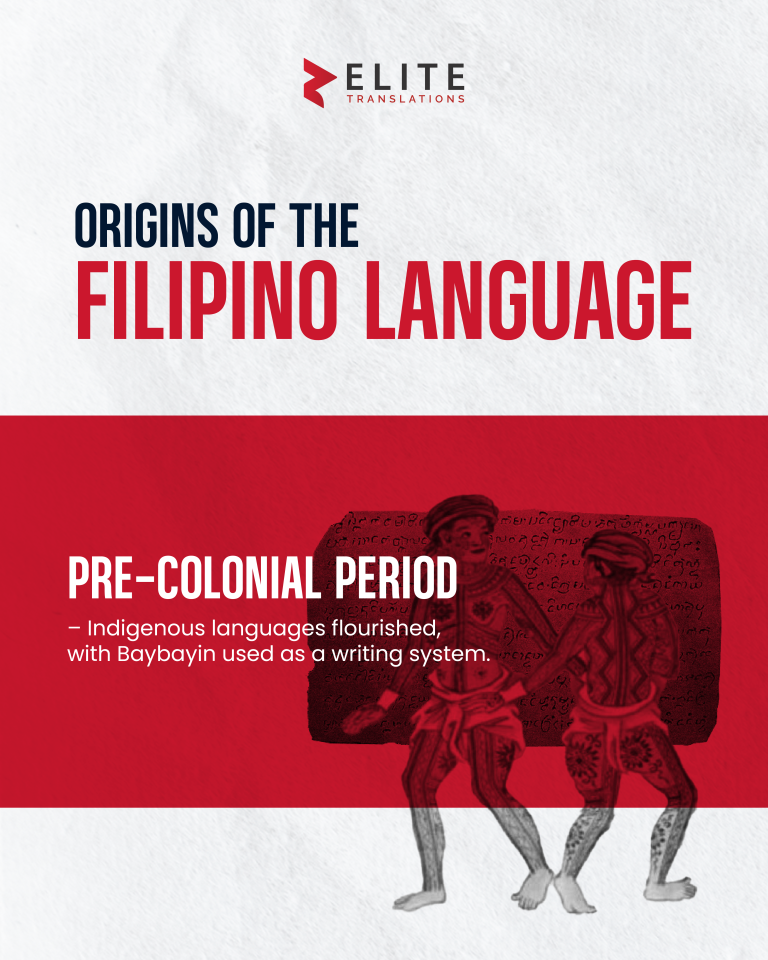
- Pre-colonial period – Indigenous languages flourished, with Baybayin used as a writing system.
- Spanish influence – From 1565 to 1898, Spanish colonial rule introduced a vast vocabulary, which remains embedded in everyday words like mesa (table) and silya (chair). Roughly one-third of Filipino vocabulary stems from Spanish.
- Tagalog as the base – In 1937, Tagalog was chosen as the foundation of the developing national language due to its literary tradition and use in Manila.
- Renaming to Filipino – In the 1970s, under President Ferdinand Marcos, the language was renamed Filipino, signaling inclusivity beyond Tagalog.
- Constitutional recognition – The 1987 Constitution formalized Filipino as the national language and emphasized its evolving nature, incorporating other Philippine languages.
Thus, the Filipino Language today embodies centuries of cultural integration and political decisions. It is both deeply traditional and continually adaptive, reflecting the Philippines’ layered identity.
Manuel L. Quezon and Why August is “Buwan ng Wika”
The story of the Filipino Language cannot be told without highlighting the role of President Manuel L. Quezon. Known as the “Father of the National Language,” Quezon championed the creation of a unifying national tongue during his presidency in the Commonwealth period. In 1937, through Executive Order No. 134, he approved the adoption of Tagalog as the basis of the national language.
His vision did not remain symbolic. In 1940, Quezon issued Executive Order No. 263, which authorized the printing of grammar books and dictionaries of the national language. At the same time, he required schools—both public and private—to teach the new language as part of the curriculum.
Quezon’s influence also explains why the Philippines celebrates Filipino Language Month in August. In 1955, Proclamation No. 186 moved the observance of National Language Week to August 13–19 each year to coincide with Quezon’s birth anniversary on August 19. This decision permanently linked his legacy to the commemoration of the language he helped establish.
Later, in 1997, Proclamation No. 1041 expanded the celebration from one week to an entire month, officially declaring August as "Buwan ng Wikang Pambansa".
Every August, schools, government offices, and cultural institutions across the country hold activities to honor the Filipino Language. In doing so, they carry forward Quezon’s vision as his advocacy inspires people to honor, teach, and value the Filipino Language in contemporary society.
Filipino Language in Modern Society
The Filipino Language plays a central role in contemporary life. It is not only the medium of casual conversation but also of education, law, government, and entertainment.
- Education – Filipino is a required subject in schools, ensuring students develop linguistic competence, cultural pride, and appreciation of national literature.
- Media and Entertainment – Newspapers, television, radio, and online platforms extensively use Filipino to reach audiences across regions.
- Government and Law – Public addresses, laws, and official communications frequently use Filipino to ensure inclusivity and accessibility.
Therefore, Filipino serves as the nation’s cultural glue. While regional languages like Cebuano, Ilocano, and Hiligaynon remain vital in local contexts, the Filipino Language ensures a unifying voice across the nation.
Common Misconceptions About the Filipino Language


Despite its importance, the Filipino Language is often misunderstood. Addressing these misconceptions helps clarify its true value:
- “Filipino and Tagalog are the same.”
Filipino is based on Tagalog but is not limited to it. It incorporates vocabulary from English, Spanish, and other Philippine languages. - “All Filipinos speak Filipino.”
In reality, many Filipinos primarily use their mother tongues. Cebuano, Ilocano, Kapampangan, and others dominate daily communication in many regions. - “Filipino has little global relevance.”
On the contrary, Filipino has spread globally through overseas communities, particularly in North America, the Middle East, and Europe.
Hence, the Filipino Language should not be dismissed as minor or rigid. Instead, it is dynamic, evolving, and increasingly influential worldwide.
Why the Filipino Language Matters Globally
Millions of Overseas Filipino Workers (OFWs) and migrants have carried the Filipino language with them. They have created vibrant communities in cities like Los Angeles, Toronto, Dubai, and Rome. The language is no longer just within the confines of the Philippines. Instead, the people have made it a global connector.
Its global significance can be seen through:
- Cultural Diplomacy – Filipino music, films, and literature bring culture to the world, and language makes this exchange possible.
- Economic Connections – Businesses and governments interact daily with Filipino-speaking employees, clients, and communities.
- Heritage Preservation – For second-generation Filipinos abroad, learning the language helps preserve cultural identity and strengthen ties to their roots.
With this, the Filipino Language is both a symbol of national identity and an international bridge. It fosters unity among Filipinos worldwide while helping the global community better understand Philippine traditions and values.
What Elite Translations Has To Offer
When it comes to professional communication, accuracy and cultural sensitivity are vital. This is where Elite Translations provides essential support. With over 15 years of expertise, Elite ensures that Filipino language projects meet international standards.
Elite Translations offers:
- Certified Translation – Filipino translations of official letters, papers, and documents.
- Interpreting Services – Professional Filipino interpreters for conferences, legal hearings, business meetings, and remote consultations.
- Regional Language Support – Expertise not only in Filipino/Tagalog but also in other Philippine languages such as Cebuano, Hiligaynon, and hundreds more.
- Fast Turnaround – Translation projects are completed within 2–3 days without compromising accuracy with an expedited option available.
- Quality Assurance – All services follow ISO standards for consistency and reliability.
Whether you are an individual preparing travel documents or an organization aiming to reach Filipino communities, Elite Translations is your trusted partner in achieving accurate, effective, and culturally appropriate communication.
Ready to Translate Your Filipino Content?
If you need reliable translation, interpretation, or localization in the Filipino Language, Elite Translations is here to help. Our team ensures your content is accurate, professional, and recognized worldwide.
Your words deserve to be understood exactly as you intend. Trust Elite Translations to make that possible. So, do not leave your communication to chance. Contact us today!
FAQs
Q: Are Filipino and Tagalog the same?
A: No. Filipino is the standardized national language based on Tagalog, but it also incorporates vocabulary from other Philippine languages and foreign sources.
Q: How many languages are there in the Philippines?
A: The Philippines has over 180 languages and dialects, with Cebuano, Ilocano, and Hiligaynon among the most widely spoken aside from the national language Filipino.
Q: Can Elite Translations help with Filipino language projects?
A: Absolutely. Elite Translations offers certified Filipino translations, interpreting, and regional language support to ensure accuracy and cultural sensitivity.