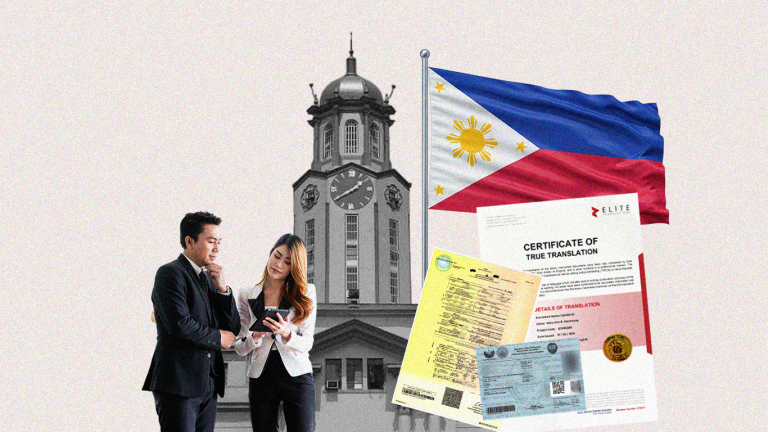
A trustworthy Manila translation agency has a verifiable office, up-to-date business registrations, recognized credentials, and certified translations backed by a signed statement of accuracy. Rates far below market norms are a warning sign. Elite Translations, an ATA-certified agency, offers certified and sworn translations plus interpreting in over 200 languages, in line with these standards.
How Do You Verify a Translation Agency's Office?
First, confirm that the agency has a real address. Check its website against Google Maps or local directories, then contact the firm and ask to meet. If an agency offers only a P.O. Box or hide its location, be cautious.
Due diligence goes a long way a long way:
- Check the listed address: Real businesses usually keep offices in business districts
- Look for local registration: A registered corporation should show its SEC number on documents, while smaller firms may register with DTI
- Visit or video-call: A legitimate agency will gladly offer a walkthrough or photos of its workspace
- Read client reviews: Independent testimonials can hint at a genuine physical presence
Remember, a genuine agency never shies away from confirming where it operates.
What Credentials Should a Manila Translation Agency Hold?
Reputable agencies back their expertise with credentials. Therefore, look for the following:
- Professional association memberships: Belonging to the American Translators Association (ATA) or the Globalization and Localization Association (GALA) signals adherence to professional standards and ethics
- Government procurement listings: A PhilGEPS supplier ID is a plus, though harder to verify
- Local business registration: A valid SEC or DTI certificate and a BIR taxpayer ID prove the company is legally registered
Together, these credentials signal professionalism and accountability.
What Should a Certified Translation Include?
A proper certified translation arrives as a complete package. Typically, it contains the original text, the translation, and a signed statement from the translator or agency attesting that the translation is complete and accurate.
Expect these elements:
- Official letterhead: It should list the company’s name, address, and registration details, such as the SEC number and BIR tax ID
- Signed certificate of accuracy: This page carries the translator’s or agency’s name, contact details, date, and signature. It is what makes the translation “certified.”
- Notarization or apostille, if needed: The Philippines has no sworn translator registry, so a certified translation may simply be notarized for added legal weight.
So, if a document lacks any of these, ask the agency to explain before you proceed.
Why Are Low Prices a Red Flag for a Translation Agency?
Indeed, cheap rates are tempting. However, extremely low prices often mean corners are cut.
Watch for these warning signs:
- Unqualified translators: Unvetted freelancers can introduce errors that damage documents or reputations
- Heavy machine translation: Automated output with minimal editing can miss nuance
- Skipped proofreading: The result may include grammar mistakes and inconsistent terminology
- Unrealistic turnaround: Lightning-fast delivery at rock-bottom rates often means one translator is juggling many jobs
Consequently, compare several quotes and ask what is included. A fair rate ensures your translation passes legal and official muster without costly rework.
Why Is Elite Translations the Manila Translation Agency to Trust?
Undoubtedly, measured against every checkpoint above, Elite Translations stands out. It is ATA-certified, features in the ATA directory, and brings over 15 years of experience across 150+ languages.
Likewise, its services reflect the same standards:
- Certified Translation: Birth certificates, diplomas, contracts, and other official papers, each with a signed certificate of accuracy on company letterhead
- Sworn Translation: In most European countries, a Sworn Translation performed by court-appointed professionals are the only translations accepted. This too is very much available at Elite Translations.
- Professional Interpreting: Trained interpreters handle remote and on-site work, including consecutive, simultaneous, legal or court, telephone, and sign-language interpreting
Moreover, Elite pairs human expertise with quality checks, holds association memberships, and follows international standards.
Staying Legally Compliant
Once you arrive in the country, maintaining your Czech Visa Requirements compliance means monitoring your residency expiration date closely.
You can submit your renewal applications starting 120 days before your permit expires.
To ensure security, send your paperwork via registered mail (“doporučeně”) and purchase revenue stamps (“kolek”) at the post office for administrative fees.
Ready to Work With a Manila Translation Agency You Can Trust?
Contact Elite Translations today for a free quote on your documents. With ATA-certified linguists and a commitment to accuracy and confidentiality, Elite can walk you through notarization or apostille whenever needed.
FAQs
What is a certified translation?
It is a translation accompanied by a signed statement attesting that it is complete and accurate. Embassies and courts often require it.
What is the difference between certified and sworn translation?
A certified translation carries the translator’s signed accuracy statement. Countries requesting a sworn translation generally accept a notarized certified translation from the Philippines.
Can Elite Translations handle urgent projects?
Yes. Elite offers rush services while still following the certification process. Notarization or apostille through DFA depends on the chosen service speed.